Quick Overview
A leading fashion brand partnered with Product Data Scrape to strengthen its competitive intelligence strategy across Amazon, Myntra, and RIGO. The company wanted to improve product visibility, optimize pricing decisions, and enrich its apparel catalog with standardized product attributes. Our solution delivered comprehensive Apparel Competitive Intelligence with Attribute Enrichment, enabling the client to monitor market trends, benchmark competitors, and enhance merchandising decisions. By integrating automated Competitive pricing data collection and attribute enrichment, the client achieved faster market analysis, improved catalog quality, and accelerated decision-making. Within a few months, the brand significantly enhanced product discoverability, streamlined competitive monitoring, and improved the accuracy of its product intelligence ecosystem.
The Client
The client is a fast-growing fashion retailer offering men's, women's, and children's apparel through its online marketplace and omnichannel retail network. Operating in an increasingly competitive digital commerce environment, the brand faced growing pressure to keep pace with rapidly changing fashion trends, aggressive pricing strategies, and expanding product assortments across leading marketplaces.
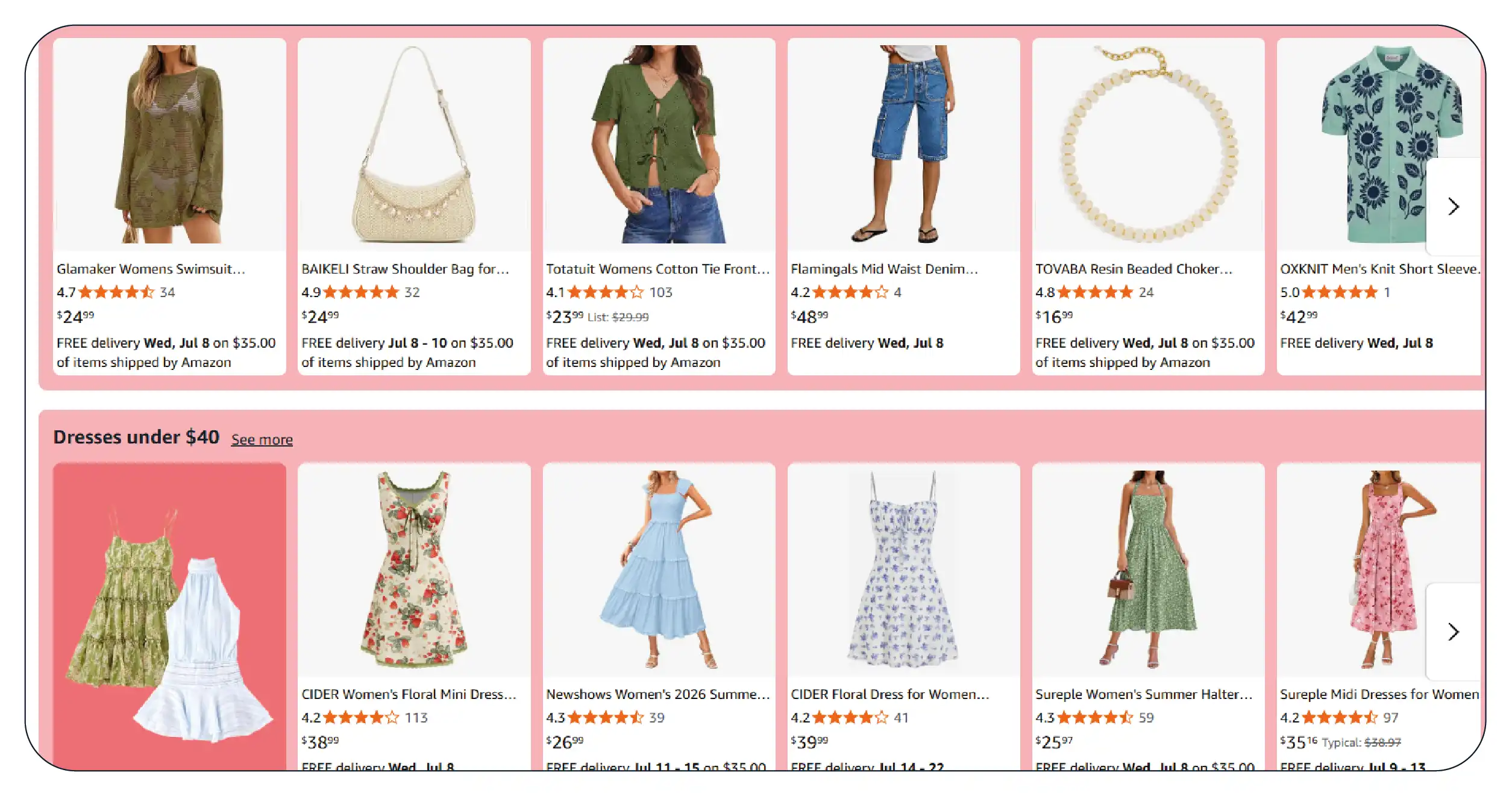
Fashion marketplaces such as Amazon, Myntra, and RIGO introduce thousands of new apparel listings every week. Consumers compare products using detailed attributes such as color, fabric, sleeve style, fit, neckline, material, pattern, occasion, and customer ratings before making purchase decisions. Without standardized product intelligence, the client found it difficult to benchmark competitors effectively or optimize merchandising strategies.
Before partnering with Product Data Scrape, the client relied on fragmented datasets collected manually from multiple marketplaces. Product attributes were inconsistent, pricing updates were delayed, and catalog comparisons required extensive manual effort. The company wanted to scrape clothing catalogs for competitive benchmarking while also transforming inconsistent product information into standardized datasets. Our platform helped them Turn messy catalogs into conversion-ready data, enabling richer product intelligence, faster competitive analysis, and more informed merchandising decisions across multiple marketplaces.
Goals & Objectives
The client aimed to establish a scalable competitive intelligence framework capable of monitoring thousands of apparel products across multiple marketplaces. The primary business goal was to improve pricing competitiveness, strengthen product positioning, and accelerate merchandising decisions through reliable market intelligence. They also wanted to scrape fashion product metadata for catalog enrichment to create consistent, high-quality product datasets that could support search optimization and assortment planning.
From a technical perspective, the client sought complete automation for product extraction, attribute standardization, competitor monitoring, and analytics. They required seamless integration with their internal reporting systems while maintaining high data accuracy and continuous updates. Additionally, implementing Demand & Trend Intelligence would allow business teams to identify emerging fashion trends, evaluate customer preferences, and optimize future product launches using real-time competitive insights.
The project measured success through clearly defined performance indicators:
Improved product attribute accuracy across marketplaces
Faster competitive catalog comparisons
Increased pricing update frequency
Reduced manual catalog processing time
Higher automation in product intelligence workflows
Improved merchandising decision speed
Better trend identification accuracy
Enhanced reporting efficiency
These measurable KPIs provided clear visibility into operational improvements while supporting long-term business growth.
The Core Challenge
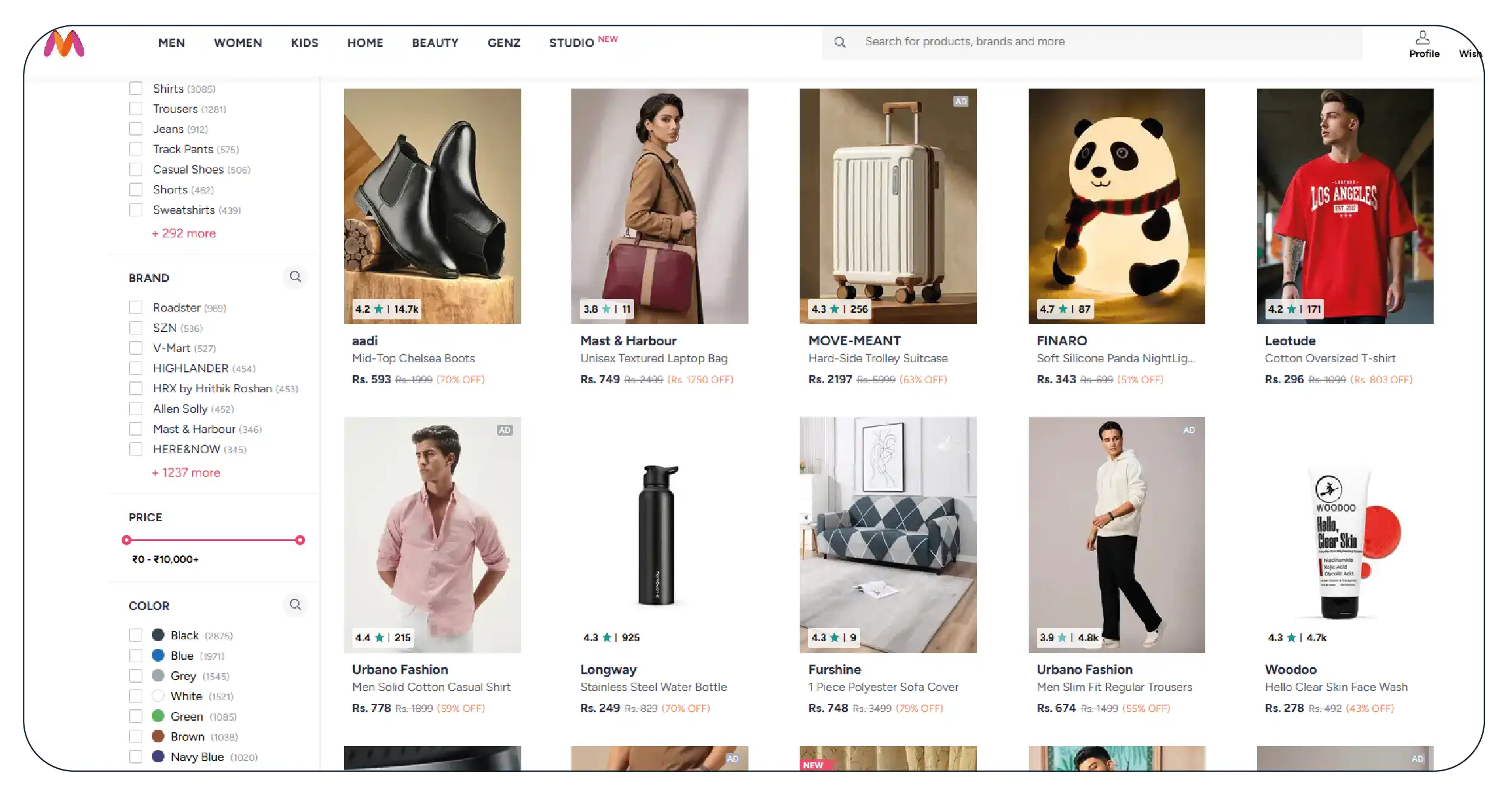
The client's largest challenge was maintaining accurate and consistent product intelligence across rapidly changing fashion marketplaces. Thousands of new apparel listings, frequent pricing changes, promotional campaigns, and inconsistent product attributes created significant operational complexity.
Manual data collection introduced delays in competitive monitoring and reduced the effectiveness of merchandising decisions. Product descriptions varied across marketplaces, making comparisons difficult. Missing product attributes, inconsistent sizing information, and duplicate listings further reduced catalog quality.
The client also struggled with Apparel Competitor Analysis Across Amazon and Myntra, as competitor assortments changed continuously throughout the day. Without automated intelligence, identifying assortment gaps, emerging trends, and pricing opportunities required extensive manual effort.
Another major challenge involved Real-time price tracking. Fashion promotions, seasonal discounts, and dynamic pricing changed frequently across Amazon, Myntra, and RIGO. Delayed updates prevented pricing teams from reacting quickly, reducing competitiveness during high-demand shopping periods. The lack of centralized intelligence also impacted inventory planning, promotional analysis, and assortment optimization.
The client needed an automated solution capable of continuously monitoring marketplace activity while delivering accurate, standardized, and actionable apparel intelligence.
Our Solution
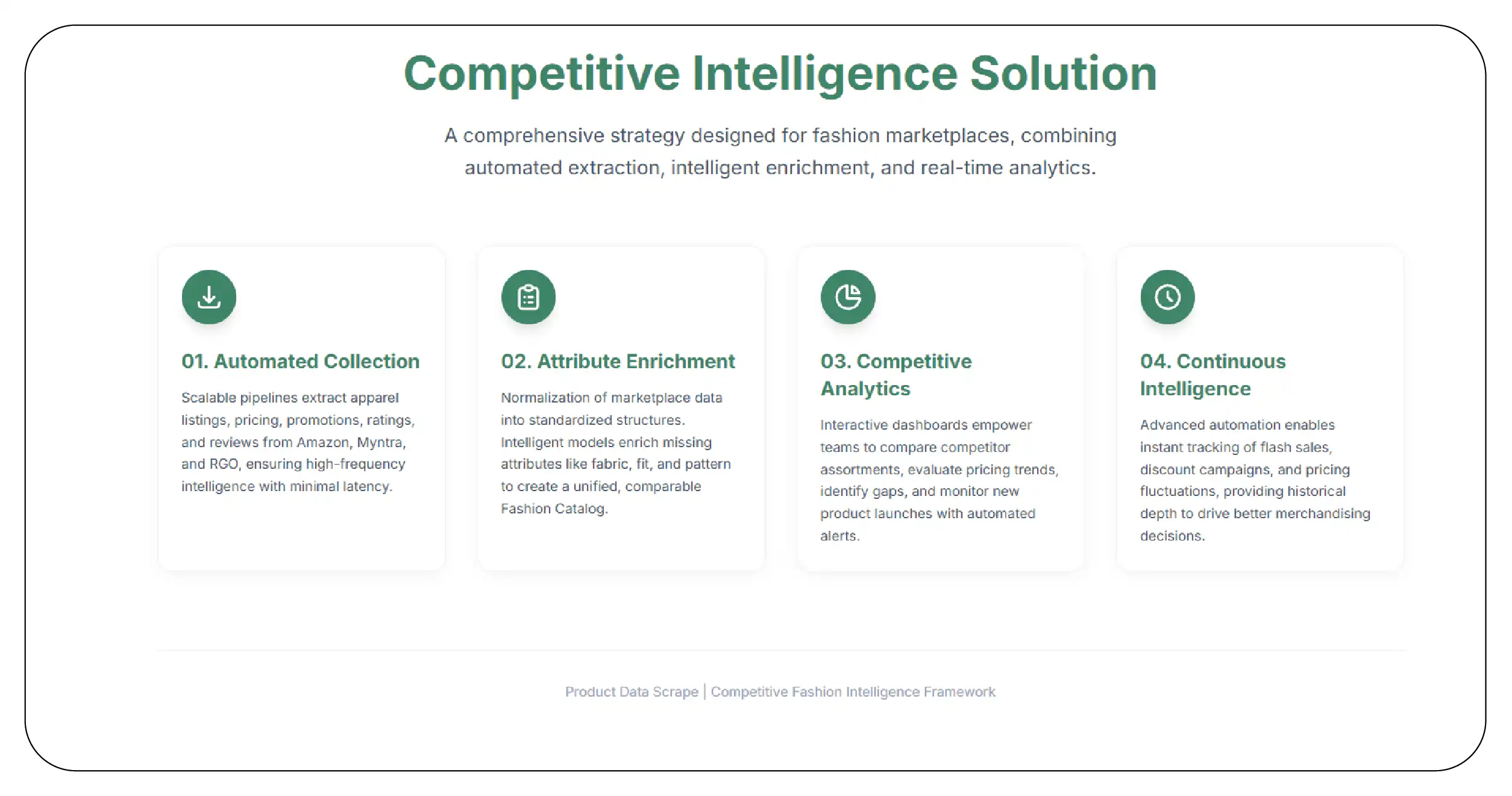
Product Data Scrape designed a comprehensive competitive intelligence solution specifically for fashion marketplaces. The implementation followed a phased approach that combined automated extraction, attribute enrichment, data standardization, analytics, and continuous monitoring.
Phase 1: Automated Marketplace Data Collection
We developed scalable extraction pipelines that continuously collected apparel listings, pricing information, promotions, ratings, reviews, inventory availability, and detailed product specifications from Amazon, Myntra, and RIGO. Automated scheduling ensured fresh marketplace intelligence throughout the day while minimizing latency.
Phase 2: Attribute Standardization and Enrichment
Raw marketplace information was normalized into standardized product structures. Missing attributes were enriched using intelligent classification models, enabling comprehensive Fashion Catalog Intelligence with Product Attribute Enrichment. Product characteristics including brand, color, material, fit, sleeve type, neckline, pattern, occasion, gender, fabric composition, and size variations were standardized for accurate marketplace comparisons.
Phase 3: Competitive Analytics
Interactive dashboards enabled merchandising and category management teams to compare competitor assortments, evaluate pricing trends, identify assortment gaps, and monitor product launches across marketplaces. Automated alerts highlighted major marketplace changes requiring immediate attention.
Phase 4: Continuous Intelligence
Advanced automation supported continuous Competitor price monitoring, allowing pricing teams to identify promotions, flash sales, discount campaigns, and pricing fluctuations almost instantly. Historical pricing trends and attribute-level analytics enabled deeper market intelligence while improving merchandising decisions.
The final solution delivered centralized apparel intelligence that replaced fragmented manual workflows with a scalable, automated ecosystem capable of supporting thousands of product comparisons daily while improving data quality, operational efficiency, and competitive decision-making.
Results & Key Metrics

Improved catalog attribute completeness through Apparel Product Data Enrichment for Competitive Analysis
Reduced manual product comparison efforts by more than 80%
Accelerated competitor price update frequency from daily to near real time
Increased product matching accuracy across Amazon, Myntra, and RIGO
Enhanced trend identification for seasonal apparel categories
Improved reporting turnaround for merchandising teams
Strengthened pricing strategy with enriched competitor insights
Increased automation across catalog intelligence workflows
Results Narrative
With Apparel Competitive Intelligence with Attribute Enrichment, the client transformed fragmented marketplace information into a centralized intelligence platform. Merchandising teams could compare products more accurately, pricing teams responded faster to market changes, and category managers identified assortment gaps before competitors. Automated attribute enrichment significantly improved product consistency, while centralized dashboards reduced reporting time and supported quicker business decisions. The client established a scalable competitive intelligence ecosystem capable of supporting future marketplace expansion without increasing manual operational effort.
What Made Product Data Scrape Different
Product Data Scrape combined advanced automation, scalable extraction infrastructure, and intelligent product enrichment to deliver highly accurate apparel intelligence. Unlike traditional scraping solutions, our platform standardized complex fashion attributes while continuously monitoring marketplace activity.
Our proprietary technology could scrape fashion product attributes across ecommerce marketplace environments and normalize inconsistent product information into structured datasets ready for analytics. Intelligent validation processes minimized duplicate records, improved attribute accuracy, and maintained consistent product mapping across Amazon, Myntra, and RIGO.
The result was a reliable competitive intelligence platform that enabled faster reporting, stronger merchandising strategies, improved catalog quality, and continuous visibility into rapidly changing fashion marketplaces.
Client's Testimonial
"Product Data Scrape completely transformed how we monitor fashion marketplaces. Their expertise in Apparel Competitive Intelligence with Attribute Enrichment gave our merchandising and pricing teams access to richer product intelligence than we had ever achieved before. Automated attribute enrichment, competitor monitoring, and pricing visibility significantly improved our decision-making speed and catalog quality. Their team delivered an exceptionally scalable solution that continues to support our growing marketplace operations."
— Director of Digital Commerce, Leading Fashion Brand
Conclusion
Fashion marketplaces evolve rapidly, making accurate competitive intelligence essential for sustainable growth. Through advanced Fashion data scraping, Product Data Scrape helped the client automate marketplace monitoring, enrich product attributes, improve catalog quality, and strengthen pricing decisions across Amazon, Myntra, and RIGO.
The successful implementation of Apparel Competitive Intelligence with Attribute Enrichment enabled faster decision-making, greater merchandising accuracy, and scalable competitive benchmarking. As digital fashion retail continues expanding, businesses equipped with intelligent product data and automated analytics will remain better positioned to respond quickly to market changes and outperform competitors.
FAQs
1. What is apparel competitive intelligence?
Apparel competitive intelligence involves collecting and analyzing competitor product data, pricing, promotions, attributes, ratings, and assortment information to support smarter merchandising and pricing decisions.
2. Why is attribute enrichment important for fashion catalogues?
Attribute enrichment improves product consistency by standardizing information such as brand, color, material, fit, size, fabric, neckline, sleeve type, and pattern. This enhances product discoverability, search relevance, and competitive analysis.
3. Which marketplaces can Product Data Scrape monitor?
Our solutions support major fashion marketplaces, including Amazon, Myntra, RIGO, Flipkart, Ajio, Nykaa Fashion, and other regional or global eCommerce platforms based on business requirements.
4. How frequently is marketplace data updated?
Depending on project requirements, marketplace data can be refreshed multiple times per day or near real time, enabling businesses to monitor pricing, promotions, stock availability, and catalog changes efficiently.
5. How does Product Data Scrape help fashion brands?
Product Data Scrape delivers automated product extraction, catalog enrichment, competitor benchmarking, pricing intelligence, trend monitoring, and customized analytics dashboards that help fashion brands improve merchandising strategies, optimize pricing, and make faster, data-driven business decisions.


 Singapore
 EMAIL
EMAIL
 PHONE
PHONE


.webp)
.webp "thumb")
.webp "thumb")
.webp "thumb")









.webp)