Executive Summary
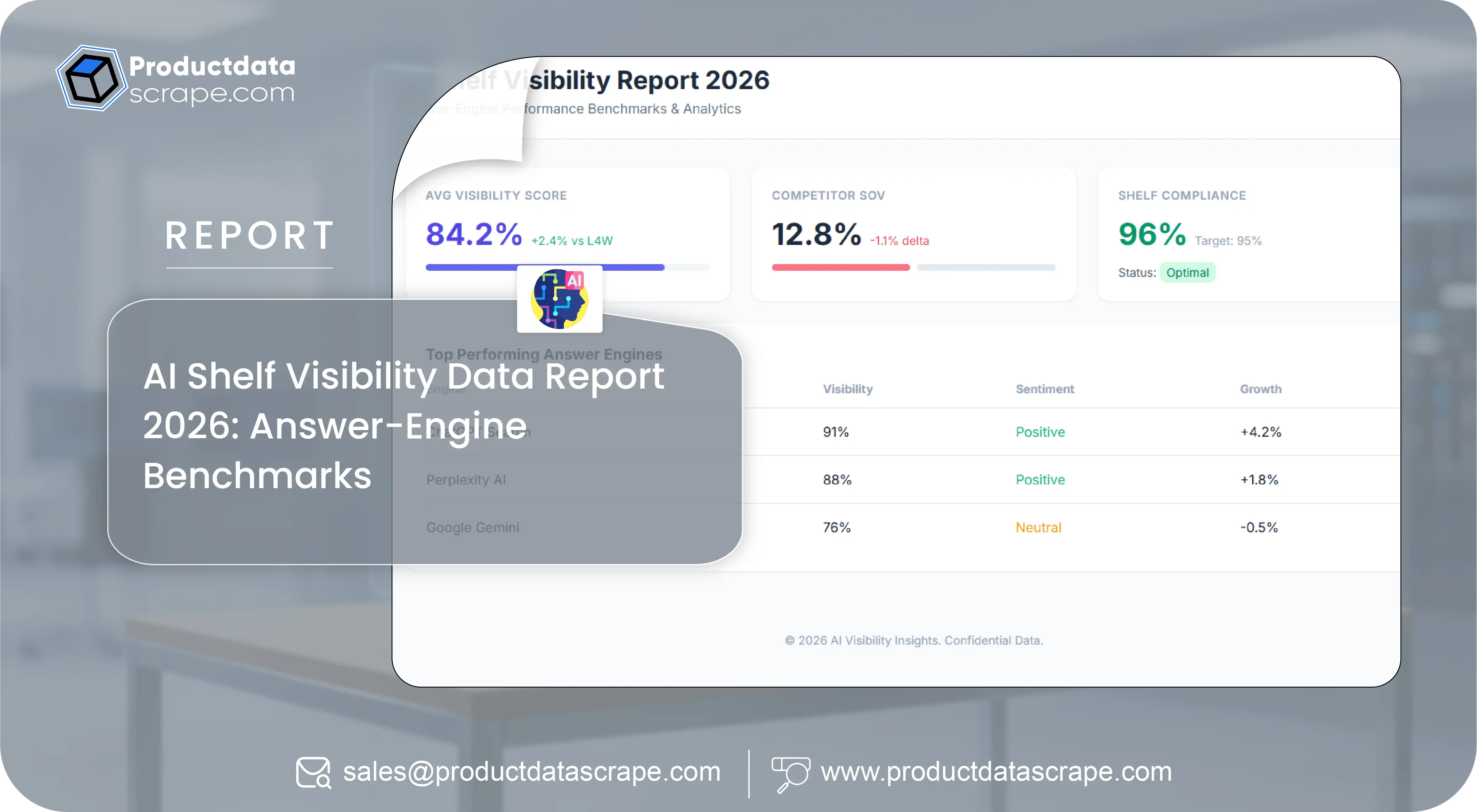
The shelf is moving into the chat window. When shoppers ask an AI assistant what to buy, the answer names a short list of products — and the brands that appear are the new front page of retail. Most brands have no idea whether they show up in these answers, how often, or why. This report from Product Data Scrape uses large-scale AI Shelf Visibility Data to benchmark which brands and products surface in ChatGPT, Perplexity, and Gemini shopping answers in 2026, and what drives that visibility.
The figures below are representative benchmarks drawn from Product Data Scrape's monitoring of AI answer engines across common shopping queries. They are designed to help brand, e-commerce, and digital teams understand answer-engine visibility — not to replace a scoped audit of a specific brand.
Why Answer-Engine Visibility Is the New Search Ranking

For two decades, winning meant ranking on the first page of search. Increasingly, it means being named in an AI-generated answer that never shows a traditional results page at all. When an assistant recommends three products, those three capture the consideration set, and everything else is invisible — a far harsher cut than a ranked list a shopper can scroll.
Answer-engine visibility works differently from classic SEO. It depends on which sources the model draws from, how a brand is described across the web, and how consistently product information appears in the places these systems trust. Brands cannot manage what they cannot see, and almost none are yet measuring their presence in AI answers. AI Shelf Visibility Data closes that gap.
What This Report Measures
For this study, Product Data Scrape ran a broad set of realistic shopping queries across leading AI answer engines and captured what each returned. Queries span category recommendations, comparisons, and specific-need questions of the kind shoppers actually ask, so results reflect real buying journeys rather than artificial prompts.
For every query and engine, the dataset records which brands and products are named, in what position, whether a given brand is mentioned at all, and which source domains the answer draws on. Rolled up, these signals produce visibility metrics — mention frequency, share of recommendations, average position, and the source domains that most influence what the models say.
Key Findings
The 2026 monitoring data surfaces several consistent patterns across engines and categories:
A few brands dominate the answers. For most category queries, a small set of brands captures the majority of mentions, and the long tail rarely appears at all.
Engines disagree. The same query returns different brand sets across ChatGPT, Perplexity, and Gemini, so visibility must be measured engine by engine rather than assumed to transfer.
Source domains decide inclusion. The brands that appear most often are those described consistently across the review sites, retailers, and reference sources these systems rely on.
Position compounds. Being named first carries far more weight than being named third, mirroring how click-through concentrated at the top of classic search.
Presence and reputation diverge. Some brands are mentioned frequently but described unfavorably, so visibility alone is not the whole story — how a brand is characterized matters as much as whether it appears.
Together, these findings show that a new, largely unmeasured layer of retail visibility has emerged — and that the brands winning it are the ones whose information is consistent and trusted across the web the models read.
Sample Data: Brand Visibility Across AI Engines
The value of AI Shelf Visibility Data is in the answer-level record behind every query. Below is a representative sample of the structured output Product Data Scrape delivers.
| Shopping Query |
AI Engine |
Brands Named |
Your Brand Mentioned? |
Position |
Top Source Domain |
Captured |
| "best budget wireless earbuds" |
ChatGPT |
Brand X, Brand Y, Brand Z |
No |
— |
review-site-a.com |
2026-07-14 |
| "best budget wireless earbuds" |
Perplexity |
Brand Y, Your Brand, Brand X |
Yes |
#2 |
retailer-b.com |
2026-07-14 |
| "vitamin C serum for sensitive skin" |
Gemini |
Brand P, Brand Q |
No |
— |
derm-blog-c.com |
2026-07-13 |
| "affordable robot vacuum" |
ChatGPT |
Your Brand, Brand M, Brand N |
Yes |
#1 |
review-site-a.com |
2026-07-13 |
| "best running shoes for beginners" |
Perplexity |
Brand R, Brand S, Brand T |
No |
— |
sports-mag-d.com |
2026-07-12 |
Every row is timestamped and engine-specific, so digital teams can see exactly where a brand appears, where it is missing, and which sources are shaping the answer.
How Brands Use AI Shelf Visibility Data
Brands that monitor answer-engine visibility use the data to compete in a channel most rivals are ignoring. First, they benchmark their share of AI recommendations against competitors by category and engine, turning an invisible battleground into a scoreboard they can act on.
Second, they identify the source domains that drive inclusion and focus their content, PR, and retailer relationships on the places the models actually trust, rather than spreading effort thinly. Third, they monitor how they are described, catching outdated or unfavorable characterizations that quietly steer shoppers away, and correcting the underlying sources.
Digital and e-commerce leaders use the same feed to track visibility over time and prove the impact of their efforts as the models update. In every case, the data gives a brand a foothold in a channel that is rapidly becoming the first place a purchase decision is shaped.
What Changed in Discovery in 2026
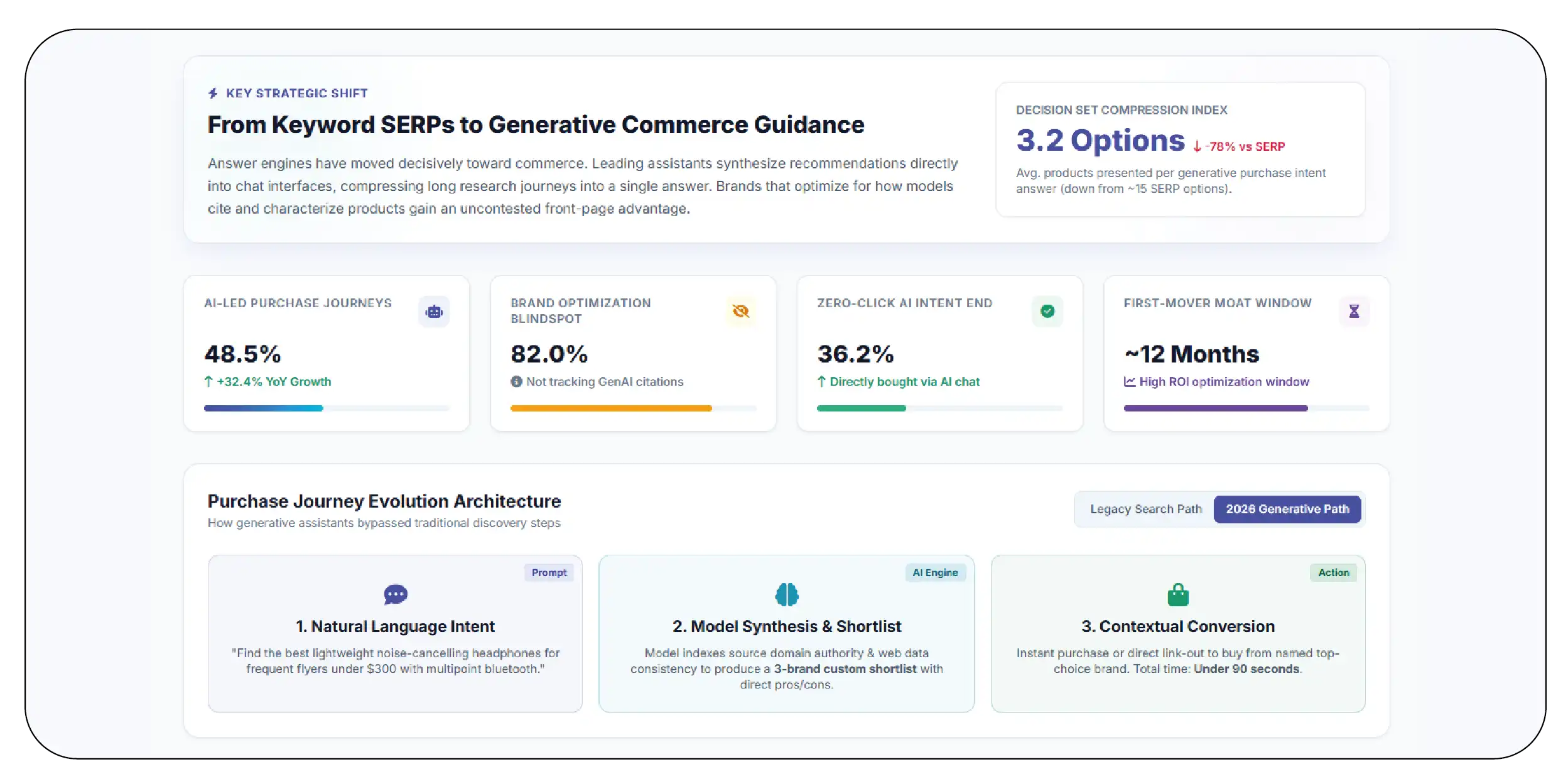
Answer engines have moved decisively toward commerce. Leading assistants have added shopping features, product comparisons, and buying guidance directly into their answers, so a growing share of purchase journeys now begins — and sometimes ends — inside a chat interface rather than a search results page or a marketplace. For shoppers, this compresses research into a single response; for brands, it compresses the entire consideration set into a handful of named options.
This has given rise to a new discipline: optimizing for how generative systems describe and recommend products, distinct from classic search optimization. The inputs are different — the source domains a model trusts, the consistency of a brand's information across the web, and how favorably it is characterized in the references these systems read. Because almost no brands are measuring this yet, the ones that start early gain a rare, uncontested advantage in the channel that is quietly becoming the new front page of retail. Measurement is the necessary first step, and it is exactly what this data provides.
AI Shelf Visibility Data FAQs
Is this the same as SEO? No. Search optimization targets ranked result pages; answer-engine visibility targets which brands a model names in its generated answer, which depends on different, source-driven signals.
Why measure each engine separately? Because ChatGPT, Perplexity, and Gemini return different brand sets for the same query, so visibility on one does not imply visibility on another.
Can query sets be tailored to my category? Yes. The monitored queries are built around the real questions your shoppers ask, and can expand as new answer engines gain share.
Methodology and Data Quality
The findings in this report are built from listing-level data collected by Product Data Scrape's managed pipelines, not from surveys or estimates. Products are captured directly from live marketplace pages at scale, normalized into a consistent schema, and matched across platforms so that every comparison is genuinely like-for-like. Prices, availability, and other fields are recorded with a timestamp, which makes it possible to measure change over time rather than relying on a single snapshot that is out of date the moment it is taken.
Every dataset passes automated validation before it is used. Duplicate listings are removed, outliers are flagged for review, and records that fail consistency checks are re-collected rather than left to distort the results. Because the pipelines are monitored continuously, coverage adapts as marketplaces change their page structures, so the data stays reliable even as the sites underneath it evolve. This is what separates a defensible answer-engine visibility benchmark from a one-off manual scrape that cannot be repeated or trusted at scale.
Who This Report Is For
This report is written for brand, digital, and e-commerce teams, SEO and content leads adapting to generative search, and marketing leaders tracking new discovery channels. If your shoppers are starting their research inside an AI assistant, answer-engine visibility is now part of your job, not a future concern.
What You Get With Product Data Scrape
Product Data Scrape delivers AI Shelf Visibility Data as a managed service across leading answer engines, so teams do not have to build or maintain their own monitoring. Coverage captures brand and product mentions, position, sentiment of the description, and the source domains behind each answer, across the shopping queries that matter to your category.
Data is refreshed on a cadence you choose and delivered in the format your team already uses — CSV, JSON, API feed, or dashboard. Because the monitoring is custom-built, query sets and engines can be tailored to your market and expanded as new answer engines gain share.
Get Your Visibility Benchmarked
The figures in this report are representative; your real answer-engine presence depends on your category and the queries your shoppers ask. Product Data Scrape will run a free sample dataset scoped to your brand and target queries, so you can see the exact fields, accuracy, and visibility metrics before committing to anything.
Request a sample to benchmark your presence in AI answers — and turn AI Shelf Visibility Data into an edge in the channel where more and more purchase decisions now begin.


 Singapore
 EMAIL
EMAIL
 PHONE
PHONE


.webp)
.webp "thumb")
.webp "thumb")
.webp "thumb")








.webp)