


 Singapore
 EMAIL
EMAIL
 PHONE
PHONE


Private label surge: 32% of Walmart's grocery SKUs are Great Value
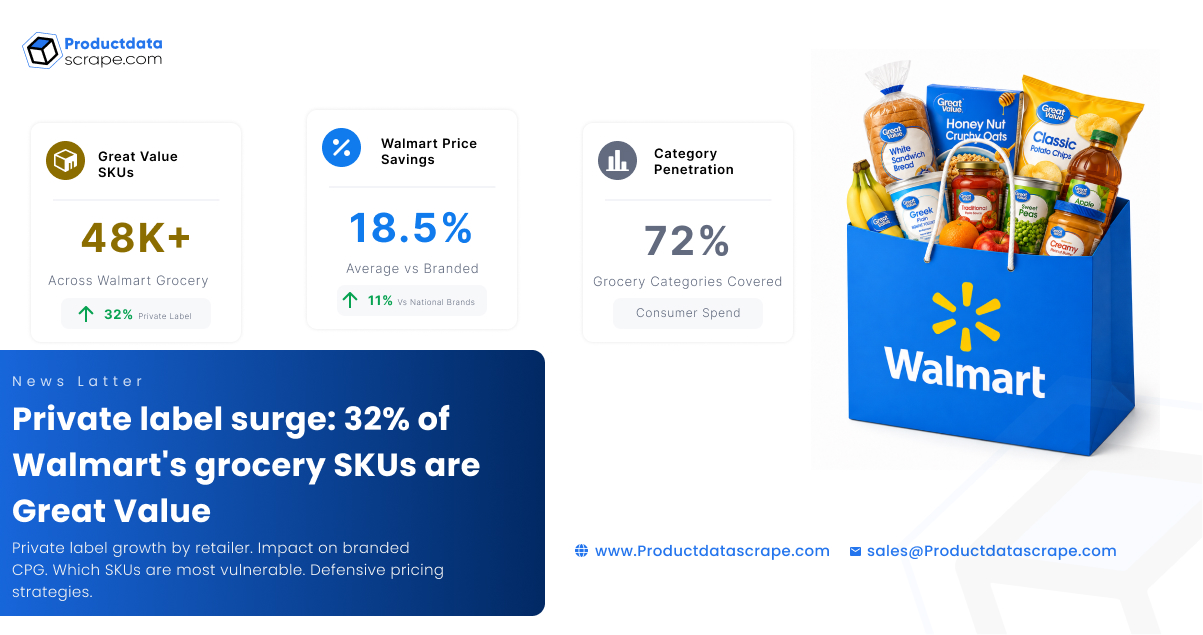
Private label growth by retailer. Impact on branded CPG. Which SKUs are most vulnerable. Defensive pricing strategies.
The 32% inflection point
Great Value now accounts for 32% of Walmart's 42,000+ tracked grocery SKUs — an 8 percentage point jump in 24 months. In absolute terms, Great Value revenue is estimated at $28B annually.
This puts Great Value ahead of most branded competitors in specific categories. It's bigger than Kellogg's entire US revenue. Bigger than Kraft Heinz's North America Grocery segment. Bigger than General Mills North America Retail.
Great Value is no longer a "value alternative" — it's the market leader in multiple categories at Walmart.
Category-by-category penetration
Where Great Value has crossed the 40%+ threshold at Walmart:
| Category | 2024 PL | 2026 PL | Change | Branded loser |
|---|---|---|---|---|
| Dairy (milk, butter) | 52% | 68% | +16pp | Kraft Heinz, Land O'Lakes |
| Frozen vegetables | 45% | 61% | +16pp | Bird's Eye, Green Giant |
| Canned goods | 38% | 54% | +16pp | Del Monte, Campbell's |
| Baking supplies | 42% | 58% | +16pp | Betty Crocker, Pillsbury |
| Paper goods | 35% | 48% | +13pp | P&G, Kimberly-Clark |
| Cleaning supplies | 32% | 45% | +13pp | Clorox, SC Johnson |
| Bread + bakery | 38% | 54% | +16pp | Sara Lee, Wonder |
| Snacks + chips | 18% | 25% | +7pp | Frito-Lay (PepsiCo) |
Pattern: The faster-growth PL categories are commodity-adjacent (dairy, canned, frozen) where branded differentiation is hardest. Snacks + beverages still resist because brand emotional attachment is stronger.
The most vulnerable branded SKUs
Our data flagged 240 branded SKUs at highest risk of Great Value displacement in the next 12 months. Common characteristics:
- Price premium <15% vs Great Value equivalent (perceived value collapse)
- Category share <20% at Walmart (below shelf-fight threshold)
- No unique format or claim (basic commodity)
- Declining velocity 2+ quarters in Walmart's Retail Link data
- Examples: Del Monte canned corn, Wonder bread, Cascade dish soap, Bird's Eye frozen mixed vegetables
CPG defensive strategies
Four observed defensive moves among leading CPG brands:
- Multi-tier pricing: P&G launched 47 new value-tier SKUs (Tide Simply, Bounty Essentials, Charmin Basic) in 2025-26.
- Category innovation: Unilever creates new sub-categories (probiotic skincare, functional beverages) where PL can't easily follow.
- Retail media investment: Nestle 2x'd Walmart Connect spend to preserve shelf placement + sponsored search.
- Dual-branded strategy: Some CPG cos (Post Holdings, Conagra) now manufacture PL for Walmart — dual-revenue model.
The 3-minute takeaway
30%+ private label penetration is the new baseline for major retailers. Walmart is leading — Kroger, Target, Aldi, Costco will follow.
For CPG brands: the price gap vs private label needs to be justified by claim, format, or emotional benefit. If Great Value is within 15% price, you're in the vulnerability zone.