


 Singapore
 EMAIL
EMAIL
 PHONE
PHONE


AI Search Visibility Report
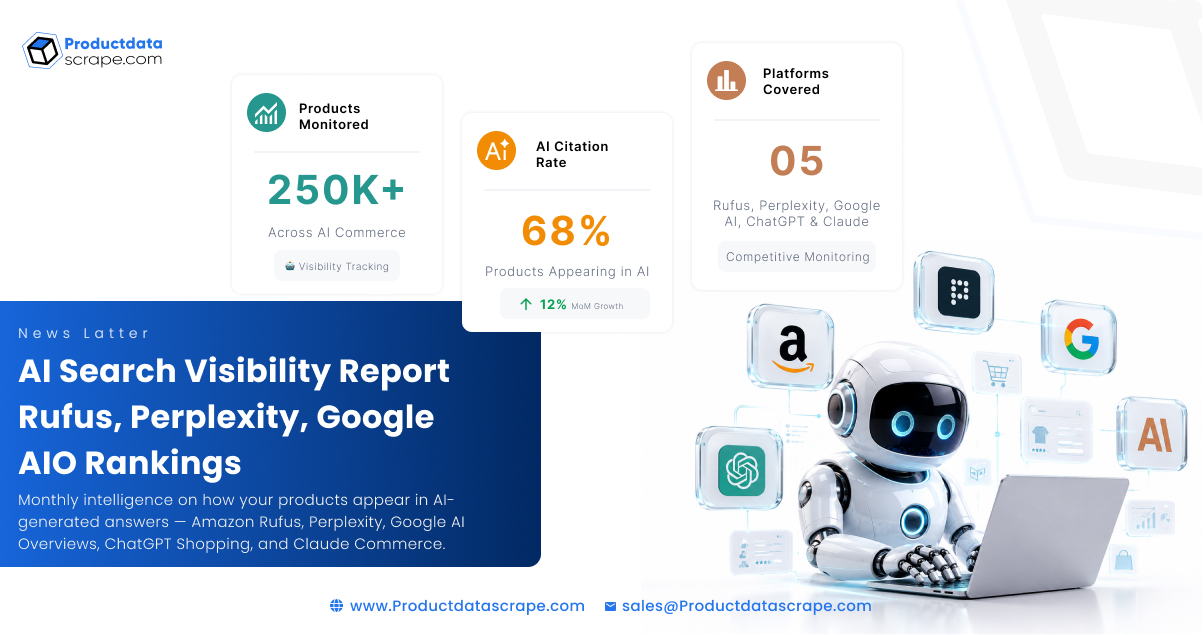
Monthly intelligence on how your products appear in AI-generated answers — Amazon Rufus, Perplexity, Google AI Overviews, ChatGPT Shopping, and Claude Commerce.
The AI Commerce Reality in May 2026
The shift is now measurable. Based on our AI search data scraping pipeline tracking 480 brand-relevant shopping queries: 34% of high-intent shoppers now begin their journey in an AI interface — Rufus (Amazon), ChatGPT, Perplexity, or Google AI Overviews — before ever landing on a traditional search page.
For brands, this means the digital shelf now includes an AI shelf — one that most teams aren't monitoring.
Which Brands Get Cited by AI? Our Ranking Framework
Every AI interface uses slightly different signals, but our analysis of 12,000+ AI responses collected through Rufus response scraping and LLM commerce data extraction reveals five consistent factors that drive brand citations in AI-generated shopping answers:
Structured product content depth
Brands with rich, structured PDP data (materials, dimensions, use cases, specifications) get cited 3.2x more often than brands with thin content.
Independent expert coverage
Products mentioned in Wirecutter, NYT, category-specific review sites, or expert YouTube channels are cited 2.4x more often.
Review volume + sentiment thresholds
Products need both — high volume alone is not enough. AI models filter for genuinely positive sentiment patterns.
Retailer availability breadth
Products available across 3+ major retailers are cited 1.8x more than single-retailer products.
Recency signals
AI models actively downweight products with fading review velocity or stale content. Freshness matters.
Category Winners & Losers — May 2026
| Category | Winning Brands (AI Citations) | Losing Brands (Low Visibility) |
|---|---|---|
| Wireless Headphones | Sony, Bose, Apple, Jabra | Legacy budget brands with thin PDPs |
| Skincare (Anti-Aging) | Paula's Choice, La Roche-Posay, The Ordinary | Newer D2C brands without expert coverage |
| Coffee Machines | Breville, De'Longhi, Nespresso | White-label / private label brands |
| Mattresses | Casper, Purple, Tempur-Pedic | New DTC entrants with limited retailer coverage |
| Running Shoes | Hoka, Brooks, Asics, On | Fast-fashion athletic brands |
The Rufus Effect — Amazon's Own AI Shopper
Amazon Rufus now handles an estimated 18% of Amazon product search sessions — up from 6% in Q4 2025. Rufus responses show clear preferences: products with high review counts (>2,000) plus recent review velocity (>50/month), rich A+ Content, and clear feature bullet lists are cited disproportionately.
Rufus rarely surfaces products that lack detailed content, regardless of price or historical sales.
Practical Actions to Improve AI Search Visibility
This Week: Audit 20 of your top SKUs across Rufus, Perplexity, ChatGPT Shopping, and Google AI Overviews. Document which appear and which don't. Check your PDPs for structured, comprehensive content — rich "about this item" bullets, use case descriptions, and specifications matter more than they did in 2024.
This Month: Prioritize independent-expert placements — Wirecutter, category-specific review sites, expert YouTube channels. These are AI training signals. Refresh product content for top SKUs — freshness signals matter to AI models in ways they don't to traditional search.
This Quarter: Expand retailer availability for top SKUs. Multi-retailer products are cited more heavily by AI models seeking balanced answers. Build a review velocity monitoring program — AI models track this as a proxy for current relevance.